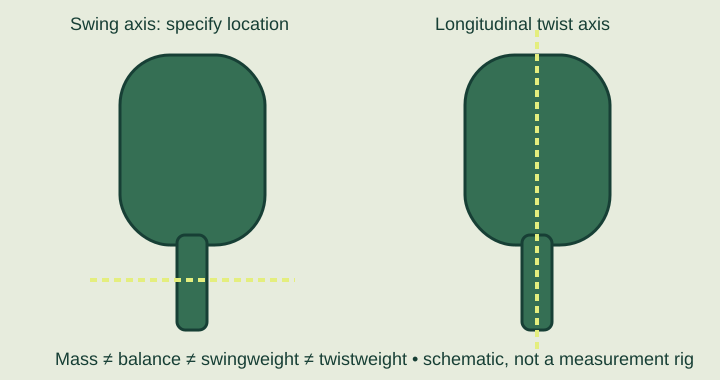
Static mass, balance, swingweight and twistweight describe different properties. A useful comparison states units, setup, sample and accessories—not just a number.
Four measurements, four questions
| Property | Question it helps answer | What to record |
|---|---|---|
| Static mass | What does this sample weigh? | Unit, scale, tape/grip state |
| Balance point | Where is its center of mass along the length? | Reference end, distance unit, method |
| Swingweight | How does mass resist rotation about the specified swing axis? | Axis, instrument, adapter, units and setup |
| Twistweight | How does mass resist twisting about the longitudinal axis? | Method, orientation, adapter and units |
The terms are measurement concepts, not player ratings. They do not by themselves establish power, injury risk, comfort, or suitability.
Why setup matters
Briffidi’s paddle procedure calls for a pickleball adapter and taring that adapter before measuring the mounted paddle. Twistweight uses its own mounting arrangement. That is a concrete reason to retain measurement setup, not just copy the final value.
Pickleball University offers measured-property tools and research. Use such resources to understand a reported property, while recognizing that a measured sample is not automatically the same setup as a retailer’s catalog range or your modified paddle.
A fictional comparison with incomplete evidence
| Report | Known | Decision |
|---|---|---|
| A: “8.0 ounces” | Static mass only | Cannot derive swingweight |
| B: “swingweight 112” | Axis and units missing | Request method before comparing |
| C: mass, axis, adapter, units and grip recorded | Reproducible setup described | More interpretable, but still one sample |
Values here are teaching examples. No manufacturer specifications or test results are being asserted.
A reviewer’s data-entry checklist
- Identify the sample, variant and accessories.
- Record instrument, calibration procedure and measurement date.
- Keep static and rotational measurements in separate fields with explicit units.
- Repeat according to the instrument’s instructions and retain spread, not only a rounded favorite value.
- Explain which conclusions are measured and which are court impressions.
We have not measured paddles. The demo notebook records user observations and never estimates swingweight from mass.
Sources and scope
Sources checked October 29, 2026. Rulebooks govern rules; technique choices and original exercises are editorial suggestions. No coaching validation or hands-on testing is claimed.